
Bipedal Robot
Published:
Summary of Work
This project was completed as part of capstone at IIT Bombay.
- Designed a 6 DoF bipedal robot with servo actuation, optimized link lengths by characterizing human anthropometry
- Integrated I2C communication to command 6 servos at a fixed rate using a timer, producing synchronous motion
- Modelled free-body IK, minimum span trajectories, and constrained control space to generate joint-space gait signals
Mechanical Design
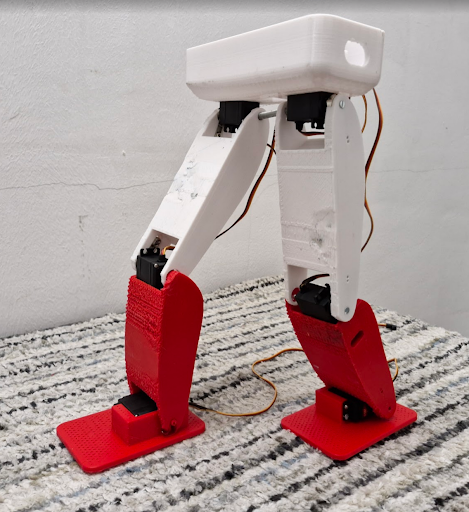
Overview
sEnVision is a 6-degree-of-freedom bipedal robot designed to replicate human-like gait using low-cost, accessible components.
System Design
The robot features six actuated joints forming a kinematic chain mimicking human motion.
Main Components:
- Material: PLA (3D printed) — lightweight, rigid, and recyclable
- Actuators: MG995 servo motors (1.2 Nm torque)
- Electronics: Arduino Uno + PCA9685 servo driver
- Power Supply: 12V 4500mAh battery
- Control Logic: Time-based trajectory interpolation for gait execution
Mechanics & Kinematics
The design uses seven links — feet, shins, thighs, and torso — connected through revolute joints to simulate natural motion.
The robot’s equations of motion were derived using the Lagrangian method, relating joint torques and forces.
Torque analysis confirmed that MG995 servos were sufficient for the robot’s motion requirements.
Gait Trajectory
The gait cycle follows human-like stance and swing phases:
- Stance Phase – foot contacts the ground, supporting body weight.
- Swing Phase – opposite leg moves forward for the next step.
Linear interpolation between joint angles ensures continuous, natural transitions between postures.
Simulation & Hardware Implementation
The gait trajectory was simulated using MATLAB, allowing fine-tuning through a custom GUI.
Hardware implementation used Arduino Uno with timed interrupts for synchronized servo motion.
Results
- Achieved smooth and stable walking gait
- Verified torque feasibility through dynamic modeling
- Observed minimal jitter in servo movement
- Lateral sway aided natural balancing
The robot demonstrated stable locomotion and effective human-like gait under constrained conditions.
Tools & Skills
Software: SolidWorks, MATLAB, Arduino IDE
Hardware: MG995 Servos, PCA9685, Arduino Uno, 3D-printed PLA
Concepts: Gait Planning, Inverse Kinematics, Embedded Control, Mechatronic System Design
Team
Contributors:
Aman Badave, Aman Khande, Arnav Patel, Hanish Dhanwalkar, Kushal Agarwal, Priyansh Gopawat, Rishikesh Pandey, Saksham Katiyar
Institution: Indian Institute of Technology Bombay
Date: November 2025